


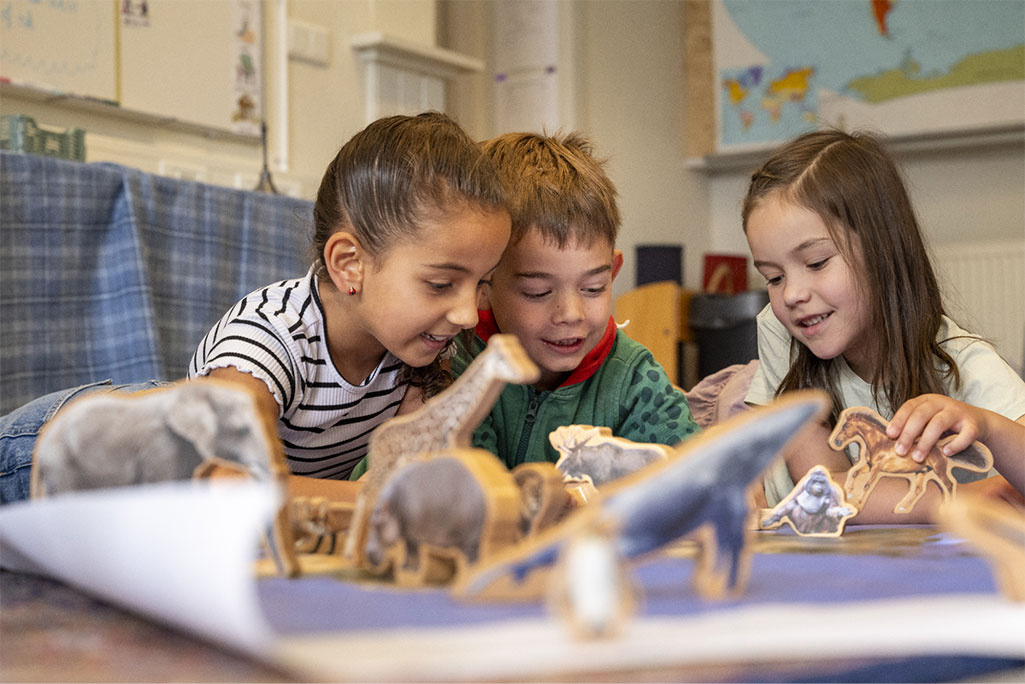

A Waldorf school teaches through art, story and hands-on work rather than through textbooks and tests. Rudolf Steiner, an Austrian philosopher, opened the first one in Stuttgart in 1919 for the children of workers at the Waldorf-Astoria factory. The model spread from there, and the schools are also called Steiner schools.
The teaching is built around one idea: a child's capacity to learn changes as the child grows, so the subject and the method should change with it. Younger children learn through play, rhythm and story. Older children move into academic subjects, still taught through drawing, drama and making things. By high school the work is analytical and independent.
The philosophy
Three principles run through every Waldorf classroom.
The whole child. Physical, emotional and intellectual growth are treated as one job, not three, and a Waldorf timetable gives real hours to all of them.
Art in every subject, not beside them. Geometry is drawn. History is dramatised. Music and painting are not enrichment slots at the end of the week; they are how the arithmetic gets taught.
Learning matched to age. Reading is introduced later than in most systems. Abstract work arrives when the school judges the child ready for it rather than when a curriculum calendar says so.
The curriculum, stage by stage
Kindergarten to Grade 2. Imaginative play, storytelling, singing, painting, baking, outdoor time. The purpose is social confidence and language, and the academic work is deliberately light.
Grades 3 to 8. Mathematics, science, history and literature arrive, taught through story, visual art and physical activity. A class teacher commonly stays with the same group of children for several years, so one adult carries the whole picture of each child through most of elementary school.
Grades 9 to 12. Specialised subjects, independent research, projects and presentations. The arts continue, but the emphasis moves to critical thinking and preparation for university or a trade.
Two practices appear in most Waldorf schools and almost nowhere else. Eurythmy is a movement art that sets speech and music into physical gesture, taught as a subject in its own right. Seasonal festivals mark the turning of the year and pull the whole school community, parents included, into the building several times a session.
Assessment without standardised tests
Waldorf schools assess through the teacher's observation, the child's own body of work, and a written report that describes progress in sentences rather than scores. Teachers who follow a cohort for years know each child well enough to write one.
For families, this is often the reason they choose the school. For the school office, it means the reporting cycle is written, individual and time-consuming, and it lands at the same moments in the year as everything else.
Where Waldorf schools are
The Waldorf associations count more than a thousand schools across upwards of sixty countries. Two directories are the usual starting point for finding one: the Association of Waldorf Schools of North America (AWSNA) and the International Association for Steiner/Waldorf Early Childhood Education (IASWECE).
What running one asks of the office
The teaching model is unusual. The administration behind it is not — it is simply heavier than most people expect, and it lands on a small staff.
A Waldorf school typically bills more than tuition. There are craft and materials fees, trips, aftercare, festival costs and, at many schools, a parent contribution or donation on top. Fee arrangements are usually settled family by family rather than by a single published rate, which means the office is tracking a different agreement for every household. Add a class teacher who moves up with the cohort, and a student's record has to stay coherent across seven or eight years and several administrators.
That is the work TUIO takes over.
Billing that matches the agreement. Each family gets the plan they agreed to — monthly, by term, or annually — and invoices go out on schedule with the extras on them. Payment receipts are automatic.
Registration and re-enrolment in one place. Forms, consents and supporting documents are collected online and land in the student's record instead of in a filing cabinet.
One student record. Contacts, emergency information, attendance and class assignment sit in a single record that follows the child from kindergarten to graduation.
Fundraising and donations. Campaigns, tracking and automatic donation receipts run in the same system as tuition, so the money side of the school is in one ledger of truth rather than two.
Support that answers the parents. Support is unlimited and included on every plan, and it covers families as well as staff, Monday to Friday, 9:00 to 21:00 Eastern. When a parent cannot get their payment to go through, they contact TUIO, not the school office.
Payments handled safely. Card details are typed into the payment processor's secure form embedded in the TUIO page and go straight to the processor's vault. TUIO never collects, transmits or stores them, which is what keeps a school in SAQ-A, the simplest PCI category. Student and family records are held in Canada, on AWS. Payouts start at 5 business days for pre-authorized debit and 3 for cards. After three months of processing with TUIO, you can apply to move to next business day.
If you are opening a Waldorf school, or running one with a two-person office, the administration is the part that scales badly. See what TUIO does with it — book a demo.
